TL;DR
- Whistic’s core model is profile exchange, where buyers request access to a stored vendor profile, and Whistic matches incoming questions against previously answered ones.
- That model still depends on someone manually refreshing the profile as controls, certifications, and product features change.
- Wolfia auto-answers questionnaires directly from a self-maintaining knowledge base, so the trust center and questionnaire answers draw from the same current source instead of a separate profile that can drift.
- Whistic is a reasonable fit for teams with a dedicated GRC hire who has time to own profile upkeep as a standing responsibility.
- Wolfia fits teams that want the knowledge base to update itself and the trust center to reflect it automatically, with source citations and a Chrome extension for portal-based questionnaires.
What is Whistic’s trust center model?
Whistic runs on a shared vendor profile. You fill out a standard set of security and compliance answers once, buyers request access (sometimes gated by NDA), and Whistic matches their incoming questionnaire questions against your stored profile answers where it can find a match.
This is a real improvement over emailing spreadsheets back and forth. It cuts the friction of re-answering the same 40 questions for every new buyer. The tradeoff is that the profile is a snapshot. It reflects whatever was true when someone last updated it, not what’s true today.
Why profile exchange still needs manual upkeep
A vendor profile only stays accurate if someone keeps editing it. When your SOC 2 report renews, when a new subprocessor gets added, when a control changes because you migrated cloud providers, the profile has to be updated by hand or the next buyer who pulls it gets stale information.
On the questionnaires we process, the recurring failure mode with profile-based tools isn’t the tool itself, it’s the second and third quarter after rollout, when the person who owned the initial setup moves to other priorities and the profile stops getting touched. Answers referencing a certification that expired six months ago are a common way that stale profiles surface, usually when a buyer’s own security team flags the mismatch.
NIST’s Cybersecurity Framework 2.0 treats identify and govern functions as continuous, not one-time. A trust center built on a static profile runs against that principle by design. The profile is accurate at snapshot time and degrades from there unless someone actively maintains it.
How does Wolfia’s knowledge base stay current?
Wolfia’s knowledge base updates itself as your policies, SOC 2 report, and prior answers change, without a librarian manually re-tagging or re-filing documents. When a new questionnaire comes in, Wolfia auto-answers directly from the current knowledge base and cites the source document behind each answer, so a reviewer can verify the answer without hunting for the underlying policy.
Because the trust center draws from the same knowledge base, publishing a new answer to a questionnaire and having it show up correctly on the trust center isn’t a separate manual step. Wolfia is built for security and GRC teams handling this exact overlap between inbound questionnaires and self-serve trust center access, where two disconnected systems tend to drift apart.
Whistic vs Wolfia, feature by feature
| Capability | Whistic | Wolfia |
|---|---|---|
| Core model | Shared vendor profile, matched against incoming questions | Auto-answer from a living knowledge base with citations |
| Answer freshness | Manual profile updates | Knowledge base updates as source documents change |
| New/unmatched questions | Routed to a person to research and write | Answered from knowledge base; low-confidence answers route to a reviewer |
| Portal coverage | Limited to Whistic’s own request flow | Chrome extension across 45+ portals (OneTrust, ServiceNow, Ariba, Coupa) |
| Pricing model | Tiered, feature-gated | All-inclusive, no caps or credits |
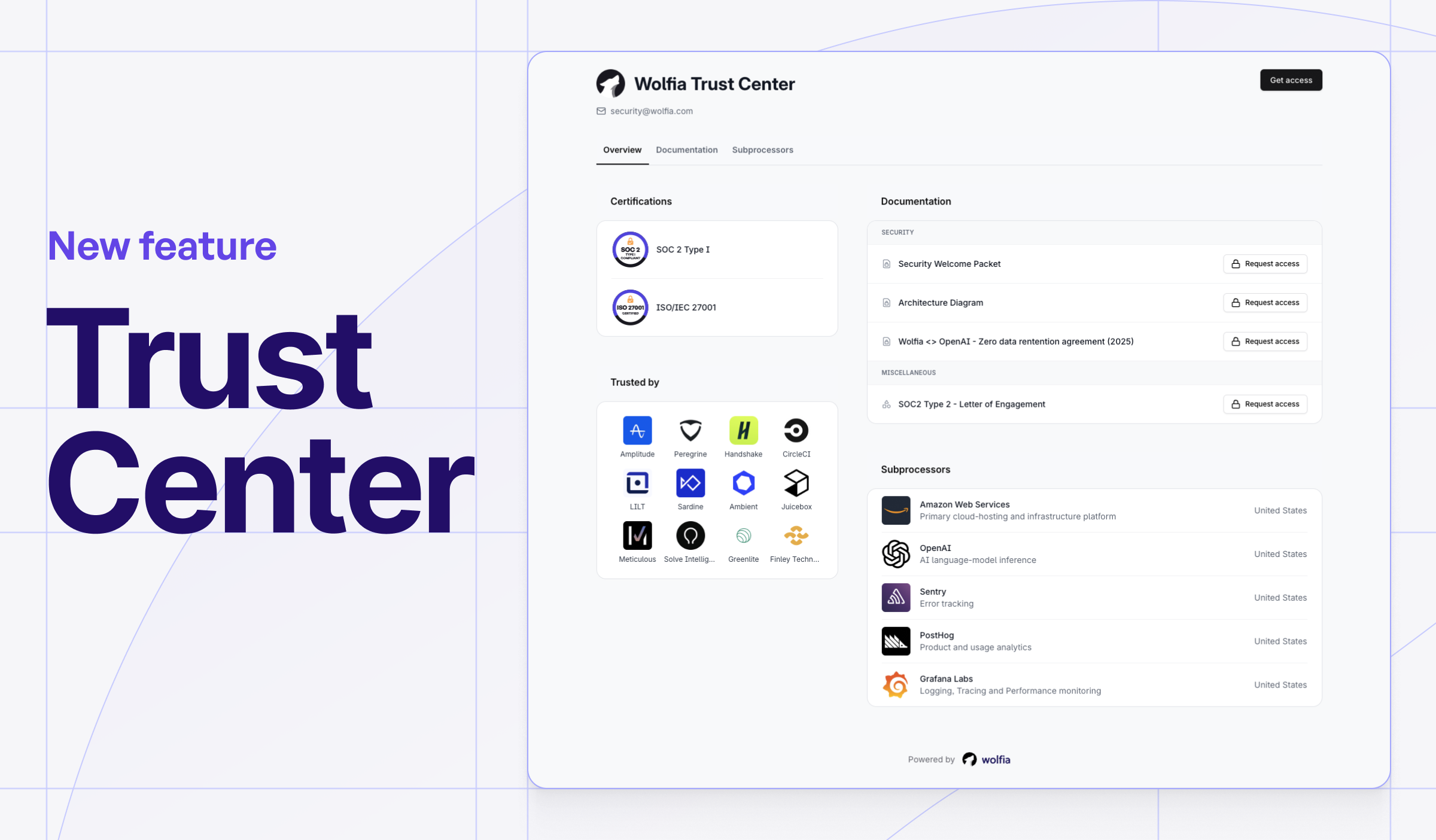
| Trust center | Yes, native | Yes, native, with NDA gating and CRM integration |
Can a trust center replace a questionnaire entirely?
Not for every buyer. Some procurement teams will accept trust center access instead of sending a full questionnaire, especially for lower-risk deals. Enterprise buyers with their own security review process usually still send a custom questionnaire regardless of what’s published on your trust center, because their own template maps to their internal risk framework, not yours.
The practical answer is that a trust center reduces volume, it doesn’t eliminate the need for questionnaire automation. If you’re only investing in one, you’ll still get custom questionnaires that a static profile can’t fully answer. That’s a scenario worth planning for before you pick a tool, and we cover it in more depth in what happens when a buyer rejects your trust center for a custom questionnaire.
How do you scope a vendor trust center rollout?
Start by inventorying which questions get asked most often across your last 10 to 15 questionnaires, then confirm your source documents (SOC 2 report, policies, subprocessor list) are current before publishing anything to a trust center. Publishing a trust center before your underlying documents are current just moves the staleness problem earlier in the buyer relationship instead of fixing it.
Most teams underestimate how much of the rollout is document hygiene rather than tool configuration. If your knowledge base is scattered across shared drives, Slack threads, and someone’s old Google Doc, no trust center tool fixes that on its own. Wolfia’s knowledge management dashboard is built to surface which source documents are stale or missing before they show up as a wrong answer in front of a buyer.
What happens to unmatched questions in each system?
In Whistic, a question that doesn’t closely match anything in the stored profile gets flagged for a person to research and write from scratch, the same manual step you’d take without any tool. In Wolfia, the same question is answered directly from the knowledge base, and if the model’s confidence is low, the answer routes to a reviewer instead of just sitting in a queue for someone to notice.
That routing difference matters more as questionnaire volume grows. A team getting 5 questionnaires a month can absorb a manual research step here and there. A team getting 30 or more a month needs the exception queue to be small, which depends on how much of the knowledge base the auto-answer engine can actually draw from.
Wolfia for teams evaluating Whistic alternatives
Wolfia is an AI platform built for customer questionnaires, RFPs, and DDQs, with a trust center, self-maintaining knowledge base, and Chrome extension across 45+ portal platforms. A few specifics are worth comparing directly against Whistic’s profile model.
- Questionnaire automation that auto-answers from the current knowledge base rather than matching against a static profile, with source citations on every answer so a reviewer can check the underlying document.
- Trust Center with NDA gating and CRM integration, fed by the same knowledge base that answers inbound questionnaires, so the two never drift apart.
- Answer auto-routing to a legal or compliance reviewer for low-confidence or high-risk answers before they go out, without a separate manual review step bolted on.
- Knowledge management dashboard that surfaces stale or conflicting source documents instead of waiting for a buyer to catch the mismatch.
- All-inclusive pricing with no caps, credits, or feature gating, so questionnaire volume growth doesn’t force a plan upgrade mid-quarter.
For a broader look at how vendor trust center tools stack up beyond just Whistic, see our comparison of the top trust center software options for 2026.
Final Thoughts
Whistic’s profile exchange model solves the “stop re-answering the same 40 questions” problem, but it hands you a new one. Someone has to keep the profile current by hand, indefinitely. That’s a fine tradeoff if you have a dedicated GRC hire with the bandwidth to own it as a standing task.
If you’d rather the knowledge base stay current on its own and have the trust center and questionnaire answers pull from the same source, that’s the gap Wolfia is built to close. Worth testing both against your actual questionnaire backlog before committing to either.